The Night Market in Zanzibar That Made Me Rethink Everything I Knew About Food
Two evenings at Forodhani Gardens in Stone Town — fifty-cent octopus, sugarcane juice, and a spice-trade history lesson — dismantled every assumption I held about what makes a meal extraordinary.
The Night Market in Zanzibar That Made Me Rethink Everything I Knew About Food
The smoke found me before the market did.
I was walking through Stone Town's narrow streets in the last hour of daylight — past carved wooden doors older than most American cities, past the sound of the muezzin's call echoing off coral-stone walls, past children playing in doorways that opened onto lives I could glimpse but not enter. And then the wind shifted, and I smelled charcoal and spice and the particular sweetness of sugarcane being pressed, and I followed it the way you follow any honest signal in an unfamiliar place: without thinking, without mapping, just moving toward what smelled like truth.
Forodhani Gardens sits on the waterfront of Stone Town, and every evening at sunset it transforms from a quiet park into one of the most extraordinary outdoor food experiences on earth. Not because the food is refined — it isn't, not in any way that food magazines would recognize. But because it is alive in a way that most dining experiences, even very good ones, are not. The market pulses with heat and sound and smoke and the particular energy of a culture that treats the evening meal as a communal event rather than a private transaction.
The Setup
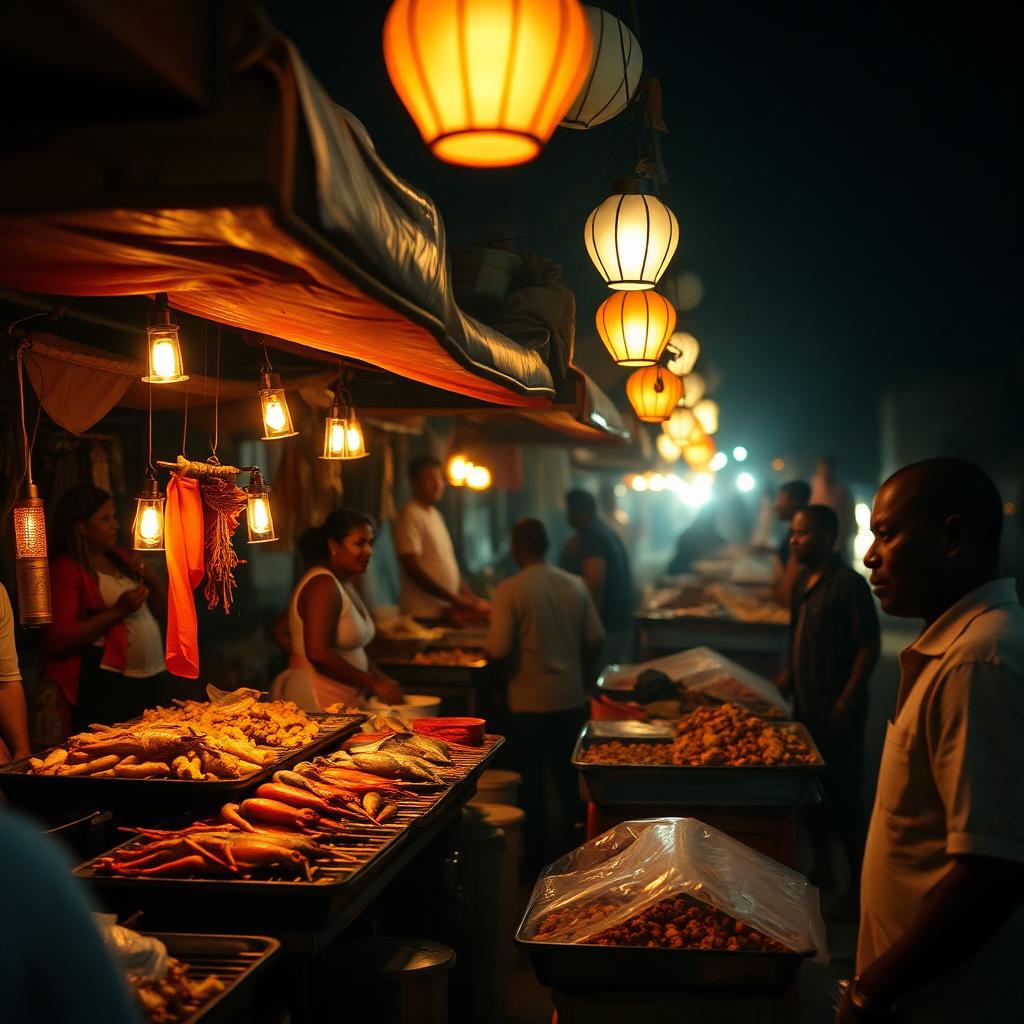
The vendors arrive as the sun descends. Wooden carts and folding tables materialize along the seawall, each one illuminated by bare bulbs powered by generators that hum beneath the conversation. The setup is chaotic and precise at the same time — each vendor knows their spot, their rhythm, their clientele. The returning customers greet their preferred grillers by name. The tourists hover, uncertain, overwhelmed by the smoke and the options and the realization that nothing here comes with a menu description or a Yelp review.
What's being cooked: Zanzibar pizza — a thin dough filled with meat, egg, vegetables, and cheese, folded on a hot griddle into something that bears no resemblance to Italian pizza but earns its name through sheer deliciousness. Mishkaki — skewered meat grilled over coconut-shell charcoal, basted with a sauce that each vendor guards as proprietary. Octopus, pulled from the Indian Ocean that morning, grilled until the edges char and the center remains tender. Urojo — a turmeric-yellow soup loaded with bhajia, boiled eggs, and crunchy toppings that reads as Indian, tastes as Swahili, and exists as evidence of Zanzibar's layered cultural history in every spoonful.
Sugar cane juice pressed through a hand-cranked machine, served in a glass with lime. Cassava chips dusted with chili. Chapati torn from a stack and used as an edible utensil. Everything costs less than a dollar. Nothing tastes like less than a dollar.
The Education
I spent two evenings at Forodhani. The first night I ate timidly — pointing at things that looked familiar, staying near the edge of the market where the crowds were thinner and the smoke was lighter. The second night I went deeper. I sat on the seawall between a Zanzibari family and a group of Kenyan travelers, and I ate everything that was offered, and something broke open in my understanding of food.
The breaking point was the octopus.
A vendor — a woman, which I noted because most of the grillers were men — handed me a piece of octopus on a wooden skewer. It was dressed with lime, chili, and a sauce made from tamarind and something I couldn't identify. I bit into it, and the flavor was so immediate, so complete, that I laughed out loud. Not because it was funny. Because it was perfect. Because perfection in a $0.50 piece of grilled octopus at a smoky night market on the coast of East Africa was so far from my previous definition of culinary excellence that the contrast itself was comic.
I had eaten at fine restaurants. I had dined at hotel properties where the chef's tasting menu ran twelve courses over three hours. I had experienced meals that were choreographed like performances — wine pairings selected, plates described by servers who'd memorized scripts, amuse-bouches designed to signal sophistication before the meal even began.
None of them tasted as honest as that octopus.
Not because fine dining isn't wonderful — it is, and I still love it. But because Forodhani stripped away every layer of performance and revealed what food actually is when you remove the theater: sustenance prepared with skill and offered with generosity. That's it. That's the whole thing. The venue doesn't matter. The plating doesn't matter. The pretense actively gets in the way.
The Spice History
You cannot understand Zanzibar's food without understanding its spices, and you cannot understand its spices without understanding its history. This island was, for centuries, one of the world's primary spice trading posts. Cloves, nutmeg, cinnamon, black pepper, cardamom — they arrived through Indian Ocean trade networks that connected East Africa to India, Arabia, Southeast Asia, and eventually Europe.
The food at Forodhani carries all of that history. The Zanzibar pizza's filling reflects Indian culinary influence. The mishkaki's preparation echoes Middle Eastern grilling traditions. The urojo soup is a direct descendant of the Indian communities that settled in Stone Town centuries ago. And the octopus — grilled simply, dressed minimally — is as Swahili as the dhow boats still anchored in the harbor.
I took a spice tour the day after my second night at Forodhani, and it connected the flavors I'd tasted to the plants that produced them. Walking through a spice farm outside Stone Town, breaking a cinnamon bark with my fingers and smelling the essential oil, pulling a clove bud from the branch — this is the kind of food education that no cooking class can replicate. You understand, in your body rather than your intellect, why these flavors matter: because they traveled thousands of miles, changed the course of trade empires, and ended up seasoning a piece of octopus that a woman grilled for me on the waterfront.
What the Market Teaches About Eating
Forodhani operates without reservations, without reviews, without the social media infrastructure that most contemporary food experiences depend on. Vendors succeed or fail based on two things: the quality of their food and the warmth of their interaction with the people eating it. There is no marketing layer between the cook and the customer. No brand identity. No curated atmosphere. Just a person making food and another person eating it, connected by smoke and flame and the shared understanding that this exchange — nourishment for payment — is one of humanity's oldest and most fundamental transactions.
I've thought about this a lot since returning home. About how much of my dining life is mediated — by reviews, by algorithms, by the aesthetic expectations that Instagram has embedded in how I evaluate a meal before I taste it. Forodhani offered no mediation. The market didn't know I was coming. The food didn't care whether I photographed it. The experience existed entirely in the present tense — the heat of the grill, the taste of the lime, the sound of the ocean behind me, the smoke that followed me back to my hotel and stayed in my hair for days.
The Rethinking
What I knew about food before Zanzibar: that quality correlates with price, that atmosphere contributes to experience, that training and technique distinguish great cooking from good cooking.
What I know now: that all of those things are sometimes true and never essential. That a woman grilling octopus over coconut-shell charcoal on a waterfront in East Africa can produce a flavor experience that rivals — and in some fundamental way surpasses — a Michelin-starred tasting menu. Not because she's a better cook. But because there's nothing between her and the food. No concept. No brand. No narrative. Just hands and heat and ingredients that arrived on the island the same way they've been arriving for five hundred years.
Forodhani didn't teach me to reject fine dining. It taught me to question the hierarchy — to ask why I'd been unconsciously ranking meals by their production values rather than their honesty. The best food I've ever eaten cost fifty cents. And the most important culinary education I've ever received happened on a seawall in Zanzibar, in the smoke, under stars that don't care about Michelin stars, while the Indian Ocean kept time behind me like a heartbeat I'd been hearing my whole life without knowing it.