Standing Inside History
We got lost trying to find it. Not once, but over and over again. This was not just another stop on the trip—this was somewhere I already knew, or at least thought I did.
We got lost trying to find it.
Not once, but over and over again—turning down streets that seemed right, stopping to ask for directions, walking in circles that did not feel like circles until we realized we had passed the same corner twice. The map did not help. It folded in ways that made sense only when you already knew where you were going.
It was summer, and the afternoon carried that particular kind of city brightness—light that makes everything look awake. The Netherlands moved around us in motion and sound: bikes cutting past with a confidence I didn't yet have, boats sliding through the canal, people speaking Dutch as if the language itself belonged to the streets.
I remember thinking that it shouldn't be this hard to find.
This was not just another stop on the trip. Not another museum, not another place to walk through and leave behind. This was somewhere I already knew, or at least thought I did.
I had learned about her in school.
Anne Frank.
I knew the outline of her story the way children are taught to know it—carefully, in pieces that felt manageable. A girl. A diary. A family in hiding. A war that ended before I was born but was still spoken about as if it had just happened.
I knew what had happened to her.
Or at least, I knew how the story ended.
What I did not know was what it would feel like to stand where she had been.
We found it eventually, not because the map became clearer, but because the line did.
It stretched quietly along the canal, a line of people waiting without speaking much, each of them already aware of where they were going. The city kept moving—bikes, voices, the small churn of daily life—but the line held a different pace, as if it had stepped slightly out of the afternoon.
There was no urgency to it. No impatience. Just a kind of stillness that felt different from the rest of the city, as if the space itself required something of you before you even entered.
We took our place at the end.
I remember noticing how long the wait was, how the line curved around the building and disappeared from view. Thirty minutes, maybe more. At eight years old, that felt like a long time to stand still for something I thought I already understood.
But it wasn't just the length of the wait.
It was the way people waited.
No one checked their watches. No one shifted in frustration. Conversations stayed low, contained, as if the line itself demanded it. There was a quiet agreement among strangers—something shared but unspoken—that this was not a place you rushed toward, or through.
I watched the people ahead of us more closely than I had anywhere else on the trip.
Trying to understand what they already seemed to know.
I knew who Anne Frank was.
I knew she had written a diary.
I knew she had hidden.
I knew she had died.
These were facts, and I carried them the way I carried everything I learned then—confidently, completely, without questioning what existed beyond them.
We waited.
People spoke quietly around us, in languages I didn't recognize, their voices low enough that I couldn't follow the conversations, only the tone. Dutch passed through the air in quick, certain sounds, and I listened the way children listen when they know they are somewhere not built for them—taking in cadence, trying to make meaning out of rhythm.
I stood beside my mother, Christine, shifting my weight from one foot to the other, looking at the water, at the buildings, at the people ahead of us, trying to understand why this felt different from every other place we had been.
When we finally reached the door, I didn't feel ready.
Not because I was afraid, but because I didn't yet know what I was about to enter.
Inside, everything narrowed.
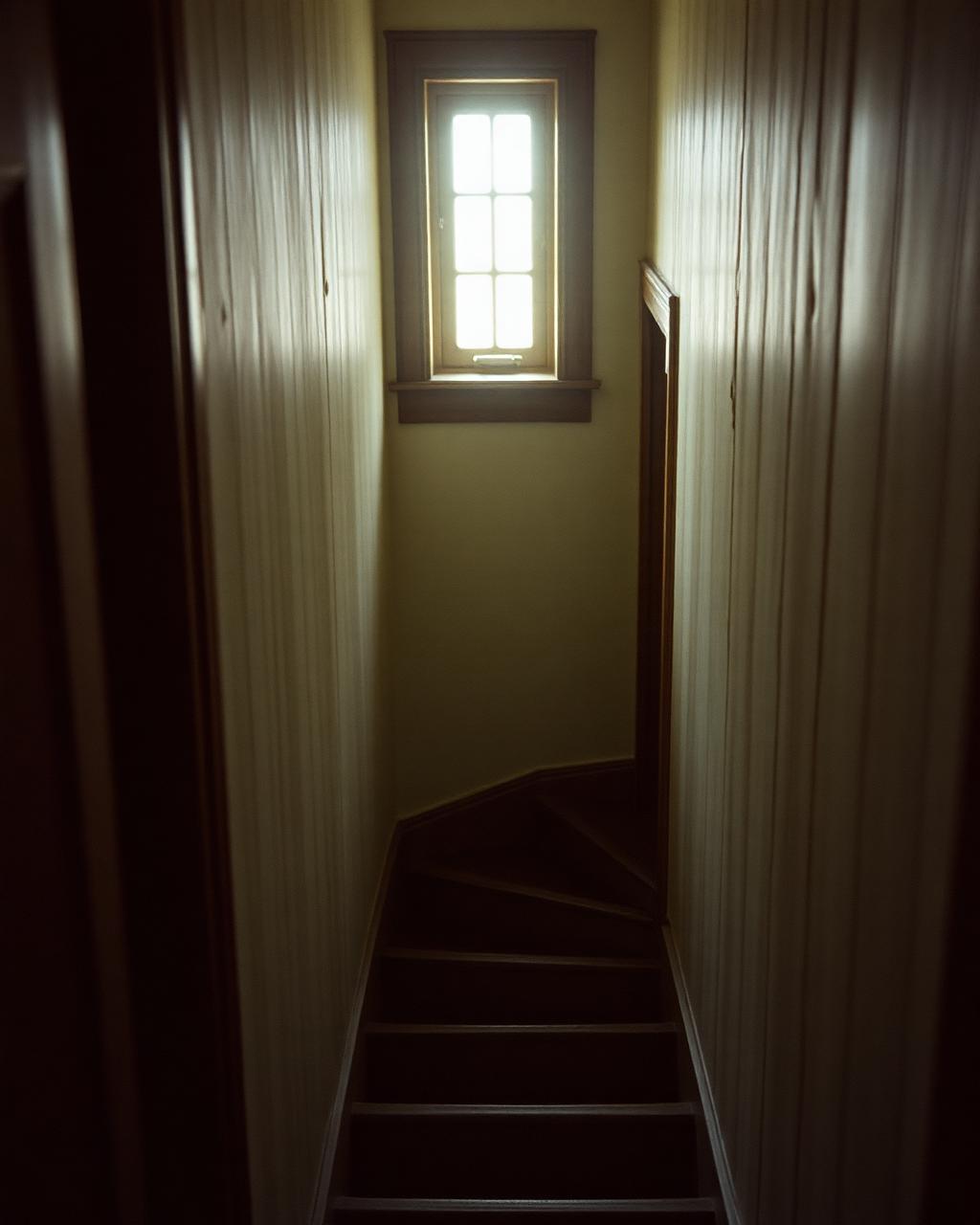
The stairs were narrower than I expected.
I remember that first—the way the space tightened as we moved upward, each step requiring more attention than the last. The walls felt closer, the air heavier, as if the building itself was holding something in place. People moved slowly, not because they were told to, but because the space did not allow for anything else.
It was darker than I thought it would be.
Not completely dark, but dim enough that it changed how you saw things. Light didn't fill the rooms—it settled in certain places and left the rest in shadow. Corners held onto it. Doorways absorbed it. Even the objects felt quieter, as if they existed with a kind of restraint.
No one spoke.
Or if they did, it was in whispers so low they barely registered as sound. The silence was not empty—it was full, dense in a way I did not yet understand. It pressed against the space the same way the air did, something you moved through rather than something you simply noticed.
I stayed close to my mother, but I wasn't afraid.
I was aware.
The rooms were smaller than I had imagined when I read about them. Not just physically, but in a way that made the story feel different. Contained. Real. The distance I had felt in the classroom—between myself and what had happened—began to narrow, though I could not yet explain why.
There were images.
Photographs. Documents. Pieces of something that had already been decided long before I arrived. Faces that did not look like the version of history I had created in my mind. They were more specific than that. More present.
And there were bookcases—ordinary in the way furniture is ordinary—until you understood what they were doing. A secret doorway hidden in plain sight. A boundary disguised as something harmless.
I remember the tightness of the space, the way crowds moved through it in careful increments, the way you could feel the presence of other bodies without being able to step away from them. I remember a window, light held back and then offered in a narrow frame, as if even daylight had to be rationed.
I looked at the images longer than I expected to.
Tracing details I didn't fully understand. The expressions. The way they held themselves. The way they looked directly into the camera, as if they knew they would be seen later, even if they did not know how.
Not because I was overwhelmed, but because I was trying to understand what I was supposed to feel.
I had learned about this.
I knew what had happened.
I knew it was tragic.
But standing there, I found myself observing more than reacting. Taking it in the same way I had taken in everything else on the trip—carefully, attentively, but without the emotional weight that I would later come to associate with it.
There was a kind of fascination in that.
Not excitement. Not curiosity in the way I had felt at other places. Something quieter. More focused. As if I were seeing something important without yet knowing why it mattered.
I moved through the space aware that something deeper existed beneath what I could immediately understand, but unsure how to reach it.
I did not feel disturbed.
That is what I remember most clearly.
Not because the space lacked weight, but because I lacked the ability to fully carry it.
I could sense that something was there—something significant, something unresolved—but it did not settle into me the way it might have if I had been older, or if I had known how to interpret what I was seeing beyond the facts I had already learned.
I understood.
But I did not feel it.
Not fully.
And in that gap—between understanding and feeling—I existed, moving through the space the same way I had moved through everything else.
Present.
Observant.
Unaffected in a way I would later question.
I have returned since then.
Not once, but multiple times, each visit carrying something different with it.
The first time I returned, I noticed the silence before anything else—the way it settled into the space before I even stepped inside, the way it lingered longer than I expected after I left.
Another time, it was the stairs again—how much narrower they felt now, not physically, but emotionally. How much more they seemed to hold.
Each visit revealed something new.
Not about the space.
But about me.
The line still forms along the canal. The rooms remain unchanged. The stairs are just as narrow, the light just as restrained, the silence just as present as it was the first time I entered.
But I am not.
The distance that once existed between what I understood and what I felt has shifted, not all at once, but gradually—with time, with study, with the quiet accumulation of experiences that begin to connect.
I no longer move through the space the same way.
I notice different things now.
Not just the physical structure, but the absence within it. The weight of what is no longer there. The lives that once filled those rooms, reduced now to fragments, to preserved pieces, to stories that must be intentionally held in place so they are not lost.
The silence feels different now.
Less like something to move through, and more like something that asks to be acknowledged.
As I've grown, as I've studied history more deeply, I've come to understand that there are places like this all over the world—spaces where the past does not remain in the past, but exists just beneath the surface of the present, waiting for those willing to stand still long enough to feel it.
I have felt it elsewhere.
In South Carolina, walking through the grounds of a former plantation, where the air carried a similar stillness, though shaped by a different history. In Royall House and Slave Quarters, not far from where I live, where the proximity of that history makes it impossible to separate it from the place itself.
The feeling is not identical.
But it is familiar.
An awareness that you are standing in a space where something has happened that cannot be undone. That the ground itself holds memory, whether you choose to acknowledge it or not.
When I was younger, I did not have the capacity to carry that awareness fully.
I could learn the facts. I could understand the sequence of events. I could recognize that something terrible had happened.
But I could not yet feel the continuity of it.
Now, I can.
Not in a way that overwhelms, but in a way that connects.
The Anne Frank House is no longer just a place where a story took place.
It is part of a larger understanding of what it means to remember.
To witness.
To stand inside something that existed long before you and will continue long after, and to recognize your role, however small, in ensuring that it is not forgotten.
There is still a part of me that returns to that first visit—the version of myself who moved through those rooms with fascination, with curiosity, with an awareness that something mattered but without the ability to fully hold it.
I do not reject her.
I understand her.
Because that distance, that gap between knowing and feeling, was not failure.
It was beginning.
It was the first step in learning how to stand in a place and allow it to change you—not all at once, but over time.
Each return has asked something different of me.
More attention. More understanding. More willingness to sit with what is uncomfortable, unresolved, and, in many ways, unanswerable.
And yet, there is something else that exists alongside that weight.
Not relief.
Not resolution.
But something closer to recognition.
A sense that these stories—these lives, these histories—continue to exist because they are remembered, because they are revisited, because people continue to stand in these spaces and refuse to let them disappear into abstraction.
There is a kind of quiet responsibility in that.
And also, unexpectedly, a kind of pride.
Not in what happened, but in what remains.
In the fact that these stories are still told. That these spaces still exist. That the past, in all its complexity and pain, is not erased, but preserved, examined, and carried forward.
I think back now to the narrow stairs, the dim light, the silence that once felt like something I moved through without understanding.
I remember the way I stood inside it.
Present.
Observant.
Trying to make sense of something I was not yet equipped to fully feel.
I understand now that this, too, was part of the experience.
That not all understanding happens in the moment.
Some of it takes years.
Some of it requires distance.
Some of it requires returning.
There are places in the world where history is no longer something you learn.
It becomes something you stand inside.
Author's Note
In 2004, I visited the Netherlands with my mother, Christine, to attend the wedding of her friends Adrienne and Ariel, who had relocated back to the Netherlands due to Roel's job and roots there. Adrienne is originally from Ireland; both had previously lived in the United States, where they met my mother. We stayed in their home, and I would return to the Netherlands again after that trip—and later, many times in adulthood as a flight attendant.